


AI for Enterprise Support and Helpdesk Teams
Resolve administrator tickets with AI. Every request becomes a governed implementation: planned with full context of your configuration, validated deterministically, and approved by your team before it ships.

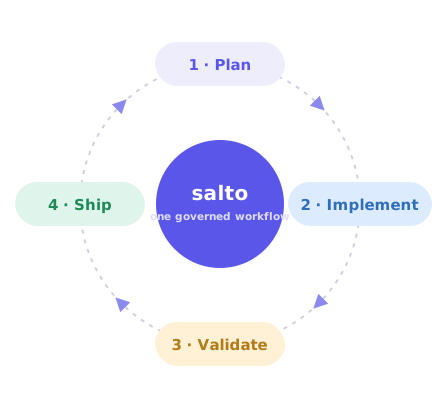

Full context of your configuration

AI plans every request against your real configuration, its dependencies, and its history.

From ticket to production
Every request ships as a validated, reviewed pull request, promoted through your environments.

Change management, enforced
Protected components, deterministic checks, drift detection, and a full audit trail.
Your experts are the queue
Every support organization has them: the two or three people who actually know how the Zendesk instance works, or why that routing rule exists. Every request waits for them. A one-field view change takes days, not because it’s hard, but because it’s queued.
The alternative people reach for is worse: direct edits in production, no review, no record, and an incident three weeks later that nobody can trace.


With Salto we don’t have to plan weekend deployments anymore—if there’s a problem, we roll it right back.

Zendesk Admin, Donnelley Financial Solutions
I thought you're just going to notify us when things happen, but this is a 1,000 steps past that. You can alert on the issues, you can map them against remediations, you can resolve the issues. This is amazing.

Staff systems engineer, PagerDuty


From ticket to production, without the queue
Ticket → AI Implementation → PR → Validation → Approval → Deployment
A request comes in through Jira, Zendesk, or your ITSM system. Salto’s AI plans the change against your real configuration and opens it as a pull request, with a plain-language explanation of what will happen and what it touches. Deterministic validators check dependencies, impact, and your compliance requirements. A person on your team approves. Salto deploys, and promotes it through your environments.
Your experts review instead of build, so the time-to-wait for the request dramatically decreases.


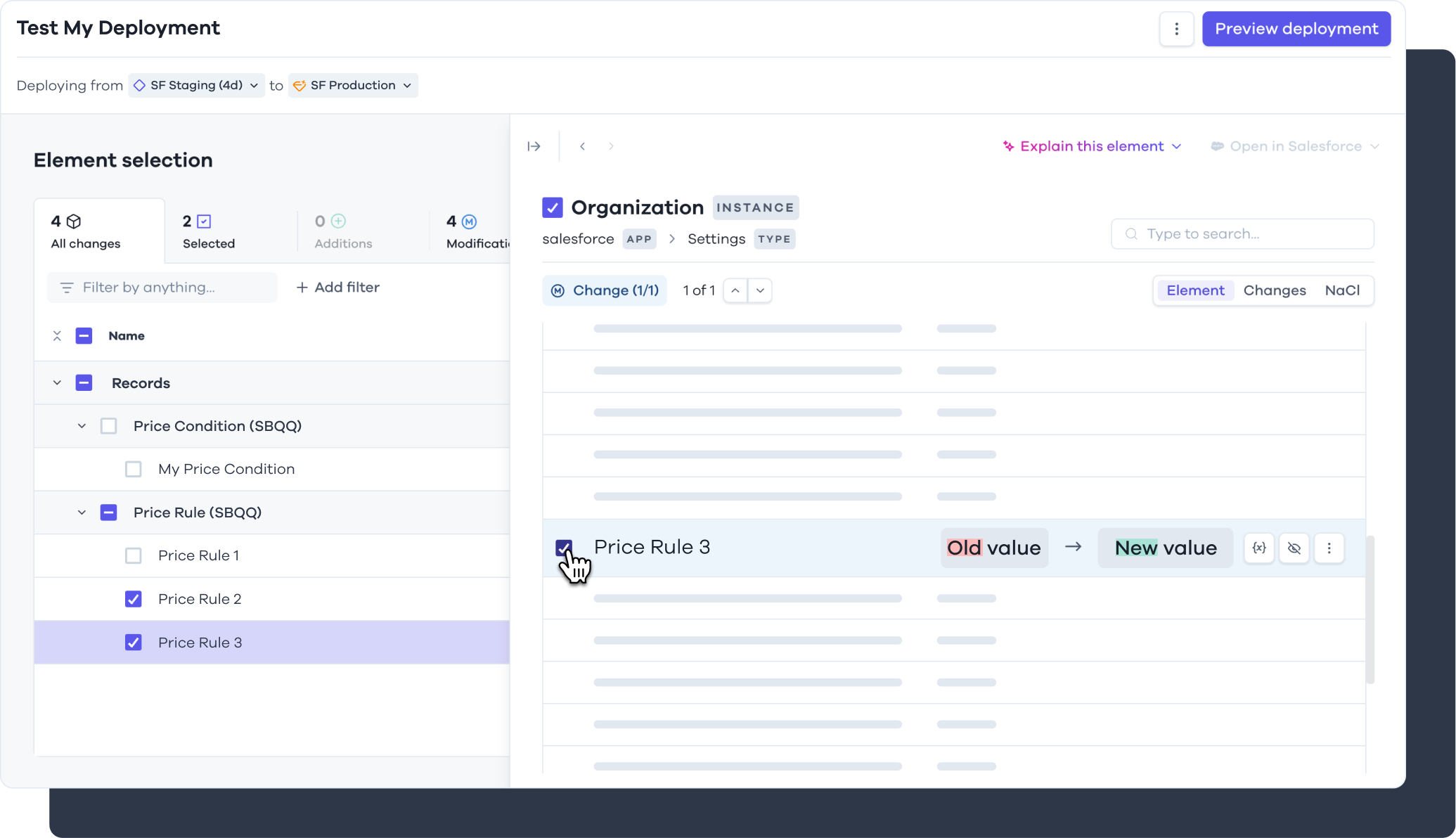


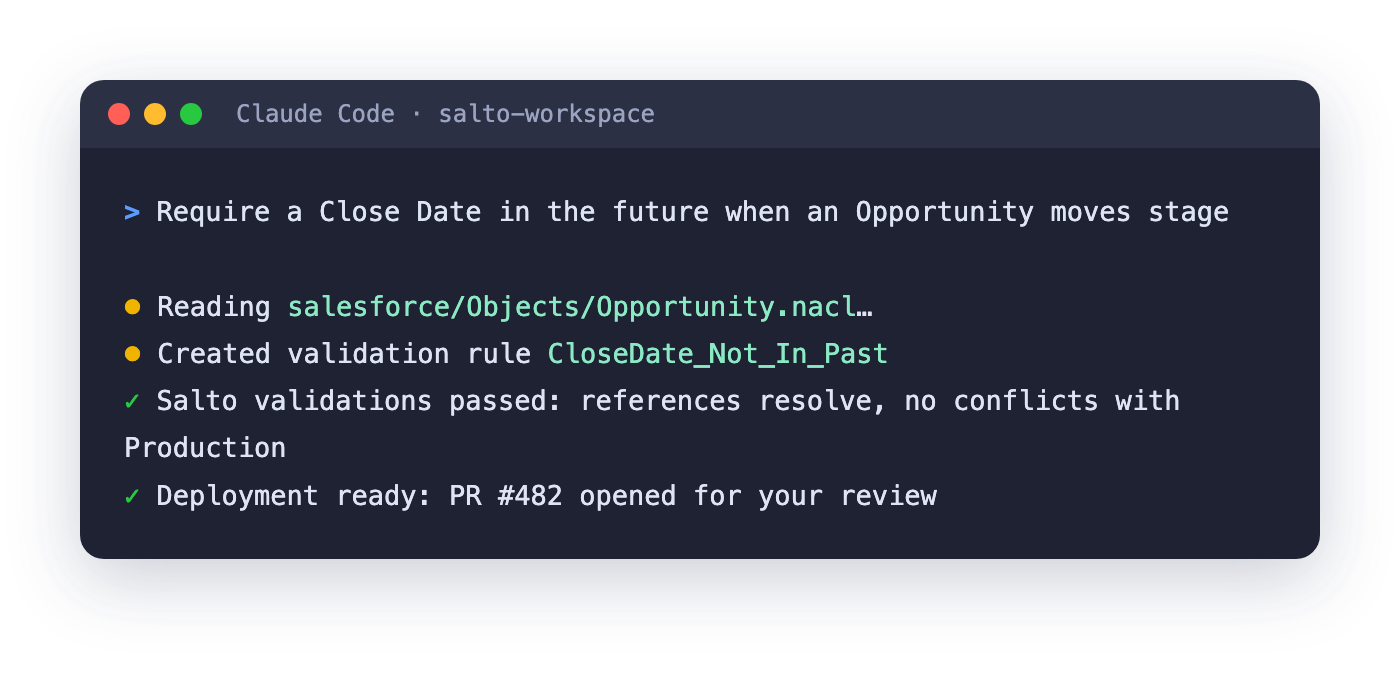

Give your platform’s AI the context to resolve admin tickets
The AI built into your support platform is good at answering questions. What it can’t do on its own is safely change configuration, and that’s what most administrator tickets actually require.
Salto closes that gap. Any AI agent, including your platform’s own, gets a complete, machine-readable model of your configuration to plan against, and a governed path to ship the change: validation, approval, deployment, promotion. Your platform’s AI stops deflecting admin tickets and starts resolving them.
Change management that enforces itself
Some components should never change quietly: role definitions, SLA policies, billing-critical automations, macros that need language approval.
Salto turns change management from a process people follow into one the platform enforces. Protected components require the right approver. Your own guidelines become deterministic checks that run on every change. Every change is validated, approved, audited, and reversible, and drift detection flags anything that goes around the process, whoever or whatever made it.
AI agents never change production directly. They build in lower environments, and Salto brings the change to production safely: validated, approved, and promoted through your pipeline.
More people shipping, without losing control
The biggest cost of the expert bottleneck is everything that never gets requested. When agents and business users can ask for a change in plain language, see a plain-language explanation of what it affects, and get it shipped through a governed flow, small improvements stop dying in the backlog.
Every change still lands in the same audit trail, with the same validation and the same approval rules. You decide who can ship what.
Where this goes: automatic resolution
Today, every change ships with a human approval, and that’s by design. But every approved change teaches the system. As your guardrails and validators accumulate, whole categories of administrator tickets become safe to resolve end to end: requested, implemented, validated, and deployed without waiting on anyone. Support organizations building that muscle now will be the ones running on it first.
Ready to get started?

The AI Implementation Platform for Enterprise Business Applications.


© Copyright Salto 2026 | Various trademarks held by their respective owners

